
April 29th, 2017 All Day Trip: Killer Whales
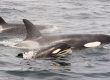
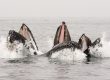
On Saturday’s 8hr all day trip we observed several humpback whales first thing in the morning and then headed out a few miles west where we found a group of 6-7 killer whales. The pod of killer whales dove, and while we were waiting for them to surface again we spotted another group of killer whales about a mile further to the north. This second group was splashing around a bit, so we headed over to see what they were doing.
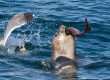
There were four killer whales; including a large male, a female, a calf and a juvenile. They had just killed a sea lion and were sharing it with each other. A little while later they found a young fur seal and killed that and ate it too. Meanwhile, the original group of killer whales we had found first headed off out of sight to the south.

Then at around 10:40am, the four killer whales took off at full speed. We traveled alongside the pod as they were “running” (traveling fast and porpoising) at 10mph. Their bearing was a completely straight line at 310° for 7.5 miles. During the “run”, we kept looking ahead to see what it was they were aiming for until finally we spotted around 15 more killer whales in the distance; and they were surrounded by birds. It was clear from all of the bird activity, the giant slick on the water, and the behavior of the killer whales that they had just predated a gray whale calf.

The 4 killer whales we’d followed for 7.5 miles must have taken off running the second they heard this distant group of killer whales beginning their hunt (sound travels extremely well in water). In the 50 minutes it took them to arrive, the other killer whales had successfully killed the gray whale calf. Multiple killer whales were zooming in and out of the area when we turned our attention to the south to see even more killer whales porpoising our direction, eager to arrive at the attack site.

Since April 19th there have been eight confirmed attacks on gray whale calves, two of which escaped predation. We believe there are around 25-30 individual killer whales which are split into separate matriarchal pods that have been involved in these attacks. Gray whale mothers and calves are the last to leave their breeding grounds in Baja and pass by Monterey Bay between April and May to reach their feeding grounds in Alaska. The killer whales take advantage of the unique geography of the Monterey Bay and disperse themselves to patrol for gray whale cow/calf pairs. The pods will often join together to hunt as a large pack when a pair is located.

It’s important to note that the gray whale population along our coast is thriving, and gray whale calves provide vital sustenance for transient killer whales. The encounter we had on April 29th was a great example of how powerful and intelligent these cooperative apex predators are. It’s incredible to know that nature, in it’s rawest form, is right here in our backyard of Monterey Bay.